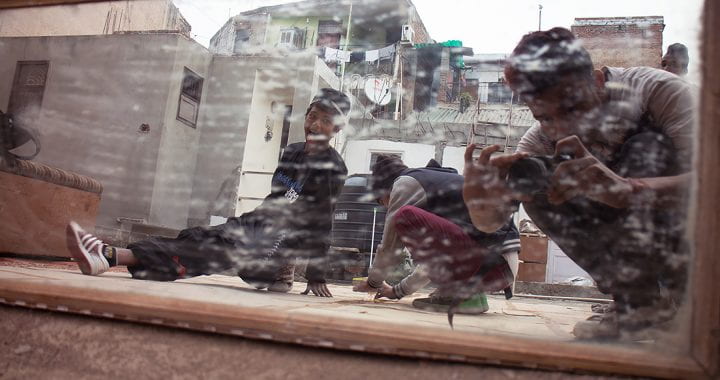
January 27, 2021 — Ethiraj Gabriel Dattatreyan — The Globally Familiar: Digital Hip Hop and Gendered Aspirations in Urban India

In the last decade, access to digital communication technologies has created opportunities for young people on the margins of the national imaginary in India to take part in transnational media worlds. In his recently published book, Dattatreyan uses the ‘globally familiar’ as an analytic to engage with the recursive effects of online media consumption, production, and circulation amongst young migrant men in Delhi who invest their energies in the Black aesthetics of hip hop. In this talk, he reflects on how, eight years after he first started fieldwork with these young men, the social and economic opportunities that have emerged for them as a result of their online/offline hip hop play continue to shape their gendered aspirations in and through circuits of late capitalism.

Ethiraj Gabriel Dattatreyan is a Senior Lecturer in the Department of Anthropology at Goldsmiths, University of London. His research engages with the ways in which digital media consumption, production, and circulation shape understandings of migration, gender, race, and urban space. His first book, The Globally Familiar: Digital Hip-Hop, Masculinity, and Urban Space in Delhi, was published by Duke University Press in 2020.

Date | Time
Jan 27, 2021 | 12:15 – 1:30 PM [PST]

RSVP by 11 AM on Wednesday, January 27th; you will receive the Zoom link and password at 11:30 AM the day of the colloquium.

To RSVP for the entire Winter 2021 series, please fill out this form.
 

February 3, 2021 — Michael Allan — World Pictures/Global Visions

This talk addresses a global network of camera operators working on behalf of the Lumière Brothers film company between 1896-1903. Not only did these camera operators record films at sites from Algiers to Berlin to Tokyo, they also pictured the world anew, whether framing a street scene in Alexandria or offering a close up on a passing face in Jerusalem. The Lumière Brothers’ broader vision was to bring the world to the world, and they imagined a global network of films easily circulable beyond the constraints of language and literacy. Engaging the implications of cinematic versus literary capture, Allan’s talk explores the stakes of world literature in the age of the world picture.

Michael Allan is an Associate Professor of Comparative Literature at the University of Oregon and editor of the journal Comparative Literature. He is the author of In the Shadow of World Literature: Sites of Reading in Colonial Egypt (Princeton 2016, Co-Winner of the MLA First Book Prize). His current research focuses on the travels of the Lumière Brothers film company across North Africa and the Middle East.

Date | Time
February 3, 2021 | 12:15 – 1:30 PM [PST]

RSVP by 11 AM on Wednesday, February 3rd; you will receive the Zoom link and password at 11:30 AM the day of the colloquium.

To RSVP for the entire Winter 2021 series, please fill out this form.

February 10, 2021 — Naya Jones — Conjure Geographies, Covid-19, and Healing Futures

Reimagining cultural healing ways is central to healing justice, Black Lives Matter, and other contemporary movements. However, “moving from race to culture to creation,” as Resmaa Menakem puts it, takes work. This talk engages in this work by centering epistemologies of Black/African-American traditional medicine, often reclaimed as “conjure.” Drawing on short stories by Zora Neale Hurston and interviews, Jones will consider how Black “knowings” of health, healing, and biomedicine continue to be both racialized and mobilized – and the urgency of taking other(ed) knowledge seriously in this pandemic moment (and beyond).

Naya Jones (she/her/hers) is an Assistant Professor of Sociology and Core Faculty in the Global and Community Health Program at UCSC. As a geographer and cultural worker, she especially studies Black geographies of community health and healing in North and Latin America (African-American and Afro-Latinx). Often in partnership with community-rooted organizations, she engages a range of storytelling, embodied, and arts-based methods. She is a former Culture of Health Leader (Robert Wood Johnson Foundation, 2017-2020) and a recent recipient of the Anne S. Chatham Fellowship for Medicinal Botany (Garden Club of America).

Date | Time
February 10, 2021 | 12:15 – 1:30 PM [PST]

RSVP by 11 AM on Wednesday, February 10th; you will receive the Zoom link and password at 11:30 AM the day of the colloquium.

To RSVP for the entire Winter 2021 series, please fill out this form.
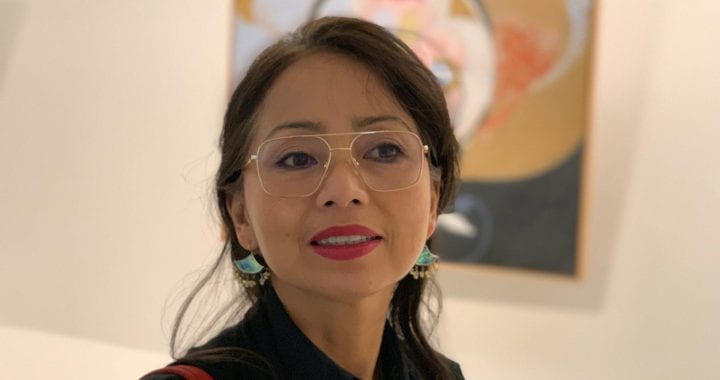
February 17, 2021 — Neferti Tadiar — A Physics Lesson: Notes on a Cultural Genealogy of Human Mediatic Forms

This talk proposes a cultural genealogy of contemporary human mediatic forms – that is, the use of humans as the media of other humans. Beginning with a reading of José Rizal’s 1891 novel, El Filibusterismo, and its encapsulation of a political moment of transformation of natives (naturales) into nationals, indios into free citizen-subjects, Tadiar explores practices and relations of humans as media in Philippine cultures and the transformation of such persistent forms of life into vital components of today’s global capitalist platform economy.

Neferti X. M. Tadiar is Professor of Women’s, Gender, and Sexuality Studies at Barnard College, Columbia University. She is the author of Things Fall Away: Philippine Historical Experience and the Makings of Globalization (2009) and Fantasy-Production: Sexual Economies and Other Philippine Consequences for the New World Order (2004). Her current book, Remaindered Life, a meditation on the disposability and surplus of life-making under contemporary conditions of global empire, is forthcoming from Duke University Press.

Date | Time
February 17, 2021 | 12:15 – 1:30 PM [PST]
This colloquium is co-presented with the Southeast Asian Center for Costal Interactions (SEACoast).

RSVP by 11 AM on Wednesday, February 17th; you will receive the Zoom link and password at 11:30 AM the day of the colloquium.

To RSVP for the entire Winter 2021 series, please fill out this form.
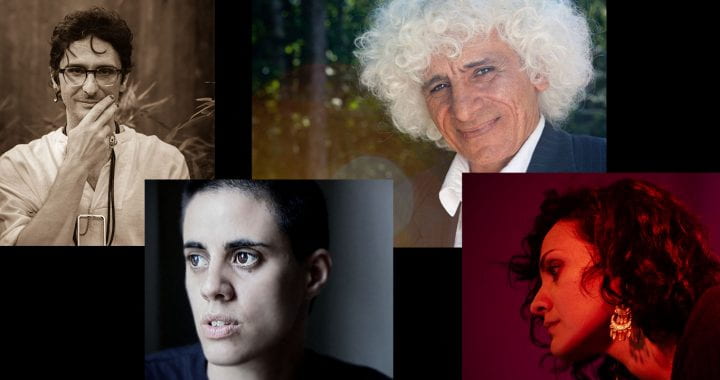
February 24, 2021 — Abou Farman, Leonor Caraballo, Sholeh Asgary & Hossein Sharang  — Terminality as Performance

Over the last eight months, the lines separating private from public domains of grief, protest from mourning, dying from being killed, the dead from the living, the fleshly from the pixellated, have been blurred. Through sound, theory, image, and affect, Farman and his collaborators explore some practices of daily resurrection and critical mourning.

With visual magic by Shelby Coley and Danielle Gauthier.

Abou Farman is an anthropologist, writer and artist. He is the author of On Not Dying: Secular Immortality in the Age of Technoscience (2020, University of Minnesota Press) and Clerks of the Passage (2012, Linda Leith Press). He is Assistant Professor of Anthropology at The New School for Social Research and founder of Art Space Sanctuary as well as the Shipibo Conibo Center of New York.

Leonor Caraballo worked as a photographer and video artist between Buenos Aires and New York. She is the co-director of the feature film Icaros: a vision. She has won a number of fellowships and grants, including the Latin American Guggenheim Fellowship, a New York Foundation for the Arts grant, and an Eyebeam Art and Technology Center residency. Leonor left her body on Saturday January 24th, 2015.

Leo and Abou conspire together as artists.

Sholeh Asgary is an Iranian-born interdisciplinary artist who creates immersive works, sound performances, and audience participatory workshops. She has participated in numerous artist residencies, including Headlands Center for the Arts (2021) and Mass MoCA (2021). Her work has been exhibited and screened at ARoS Art Museum, Sotheby’s Institute of Art, Minnesota Street Projects, and Gray Area Foundation for the Arts. She is a lecturer in the Department of Art Practice at UC Berkeley.

Hossein Sharang is the founder and president of the Wild Republic of Sharangestan.

(Hossein’s contribution includes music by Claude Maheu.)

Date | Time
February 24, 2021 | 12:15 – 1:30 PM [PST]

RSVP by 11 AM on Wednesday, February 24th; you will receive the Zoom link and password at 11:30 AM the day of the colloquium.

To RSVP for the entire Winter 2021 series, please fill out this form.
March 3, 2021 — Dard Neuman — Hindustani Music and the Politics of Creativity

This talk discusses music and the politics of creativity in the context of South Asia more broadly and Hindustani music more specifically (what is today called “Indian classical music”). Neuman traces how elite Muslim (sharif) culture became radically disrupted after British rule was formalized in 1857, and court musicians were dispersed throughout India, with many lineages and traditions quickly fading to obscurity, while a new class of hereditary musicians emerged. These new musicians came from predominantly low-class Muslim bardic communities, and their socio-musical innovations can be better understood in relation to their forceful critiques of feudal hierarchies and caste exclusions. Through oral histories, family genealogies and analysis of music performance, Neuman traces how musicians from “outsider” lineages integrated aesthetic and ideological knowledge systems to forge a fundamentally new socio-musical aesthetic, one that broke from established traditions to widen access to non-elite lineages, but did so in ways determined by heterodox and populist Sufi/Bhakti ideologies and socio-musical translations of classical sources.

Dard Neuman is the Hasan Endowed Chair in Classical Indian Music and Associate Professor of Music at the University of California, Santa Cruz, as well as Co-Director of the Center of South Asian Studies. He received his Ph.D. in Anthropology from Columbia University in 2004 and joined the Music faculty at UC Santa Cruz in 2005. He has studied the sitar for almost four decades. His research interests concern the musical cultivation, transmission and performance of Hindustani music in twentieth century North India as well as the role of music in social action. He has published articles for SEM and Asian Music and his book, Hindustani Music, Heterodoxy and the Politics of Creativity is forthcoming with Wesleyan University Press.

Date | Time
March 3, 2021 | 12:15 – 1:30 PM [PST]

RSVP by 11 AM on Wednesday, March 3rd; you will receive the Zoom link and password at 11:30 AM the day of the colloquium.

To RSVP for the entire Winter 2021 series, please fill out this form.
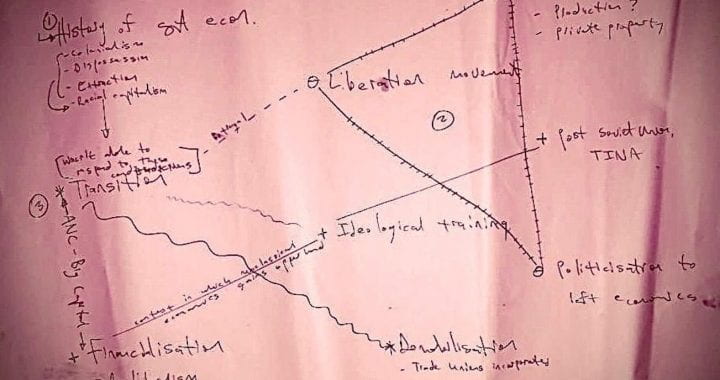
A brainstorming map related to the film Re/Distribute

October 7, 2020 — Kelly Gillespie, Asher Gamedze & Rasigan Maharajh — Re/Distribute: Three Radical Economists on (Post)Apartheid (film screening + discussion)

Two radical collectives in South Africa working inside and outside the academy to agitate against ongoing histories of dispossession consider what redistribution means in the most unequal national context on earth. This 50-minute film looks at how the promises of redistribution in the anti-apartheid liberation movement were foreclosed during the transition out of apartheid in South Africa. The film features three left economists who were active in the anti-apartheid movement but have lived through a transition in which the promise and idea of redistribution was abandoned as South Africa inserted a post-apartheid project into global processes of financialization and neoliberalization.

We will screen the film and then discuss it with filmmakers Asher Gamedze and Kelly Gillespie and featured economist Rasigan Maharajh.

Kelly Gillespie is a political and legal anthropologist and cultural worker with a research focus on criminal justice and abolition in South Africa. She works at the department of Anthropology at the University of the Western Cape. She writes and teaches about urbanism, violence, sexualities, race, and the praxis of social justice. In 2008 she co-founded the Johannesburg Workshop in Theory and Criticism (JWTC). 

Asher Gamedze is a cultural worker based in Cape Town, South Africa, working mainly as a musician, student, and writer. He is also involved, as an organiser and an educator, with various cultural and political collectives such as Fulan Fulan, The Interim, and Radical Education Network. His debut album, dialectic soul, was released in July 2020.

Rasigan Maharajh is an activist scholar whose research focuses on the political economy of innovation and development, including the changing world of work, democratic governance, and ecological reconstruction. He is the founding Chief Director of the Institute for Economic Research on Innovation based at the Tshwane University of Technology and Professor Extraordinary of the Centre for Research on Evaluation, Science and Technology at Stellenbosch University.

Date/Time
Oct 7, 2020 | 12:15 PM – 2 PM

RSVP by 11 AM on Wednesday, October 7th to receive Zoom link and password.

October 14, 2020 — Samia Khatun — Race, Gender & New Epistemic Grounds: Cross-Cultural Encounters in Desert Australia

At the forefront of white nationalist border regimes, the Australian nation-state has long operated as an Anglo imperial outpost in the Indian Ocean world. If we look at Aboriginal language archives about South Asians, however, we see alternative epistemic grounds and spatial imaginations on which we can situate historical storytelling about race, gender, and migration. This presentation will follow two Muslim men into Australian deserts, where they encountered two Aboriginal sisters waiting for a train at a lonely railway station c.1897.

Samia Khatun became a feminist historian because she once lost her way to a mathematics lecture at the University of Sydney. Since then, Khatun has chased truths about the past in Sydney, Antigua, Kolkata, Istanbul, Berlin, New York, Dunedin, Melbourne, London, and Dhaka. She researches the life-worlds of people colonised by the British Empire and her documentaries have screened on ABC and SBS-TV in Australia. She is the new Chair for the Centre for Gender Studies at SOAS, London.

Date/Time
Oct 14, 2020 | 12:15 PM – 1:30 PM

RSVP by 11 AM on Wednesday, October 14th to receive Zoom link and password.

A image of two people dancing

October 21, 2020 — Gerald Casel & GERALDCASELDANCE — Not About Race Dance

Not About Race Dance is a collaborative, choreographic response to the homoraciality that haunts U.S. American postmodern dance. The work’s title reflects its primary impetus, Neil Greenberg’s Not About AIDS Dance (1994), which discursively refused the project’s central focus to underscore its appeal for public acknowledgment of the lived experiences and losses of the AIDS crisis. Not About Race Dance employs this central paradox to call attention to how whiteness historically formed the structures, experiences, and experiments of postmodern choreographers; whiteness is the “not race” that Not About Race Dance exposes as a durable history and dominant social structure perpetuated through modern and contemporary dance practices. During this presentation, artistic director Gerald Casel and the other artists/collaborators will share and discuss this most recent choreographic explorations during COVID-19.

Gerald Casel is a dance artist, performance maker, cultural activator, and educator. He serves as the Provost of Porter College and is Associate Professor of Dance at UC Santa Cruz. He is the artistic director of GERALDCASELDANCE. His choreographic research and social practice converge to complicate and provoke questions surrounding colonialism, collective cultural amnesia, whiteness and privilege, and the tensions between the invisible/perceived/obvious structures of power.

GERALDCASELDANCE is a San Francisco-based company that strives to invent new movements and structures that seek explanations for what humans fear, love, and hate. The company supports collaboration between dance, sound design, and emerging technology, mixing performance with recorded and live video projections to enhance the experience of seeing and feeling dance.

Date/Time
Oct 21, 2020 | 12:15 PM – 1:30 PM

RSVP by 11 AM on Wednesday, October 21st to receive Zoom link and password.

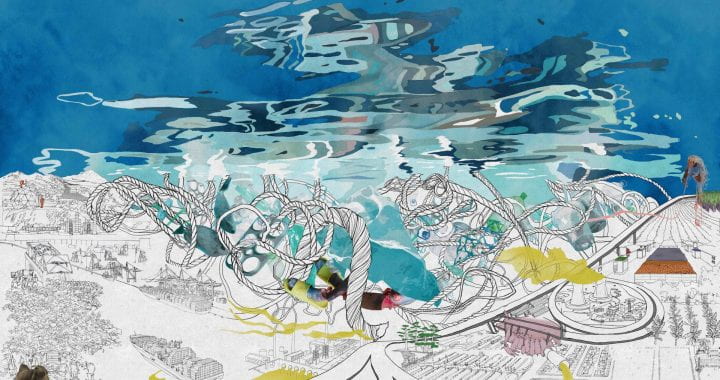
Abstract illustration of a scene in the ocean

October 28, 2020 — Anna Tsing — Feral Atlas: The More-than-Human Anthropocene

A collection of maps, a game, an archive, an analysis, a meditation on life on Earth: Feral Atlas is the cumulation of a five-year curatorial project involving more than a hundred scientists, humanists, poets, and artists. Stretching the concept of the map, the atlas shows how imperial and industrial infrastructures have had world-ripping effects on the ways humans and nonhumans live together. A diversity of observers, from Indigenous elders to research scientists, bring us beyond transcendent terror and hope into the present.

Anna Tsing is Professor of Anthropology at UC Santa Cruz. She is the author of The Mushroom at the End of the World (2015), Friction: An Ethnography of Global Connection (2005), and In the Realm of the Diamond Queen (1994). Tsing is the recipient of a Guggenheim Fellowship and a Niels Bohr Professorship for a multi-year project on the Anthropocene. She is interested in multi-species anthropology; social landscapes and forest ethnoecologies; globalization; feminist theory; and multi-sited ethnography.

Date/Time
Oct 28, 2020 | 12:15 PM – 1:30 PM

RSVP by 11 AM on Wednesday, October 28th to receive Zoom link and password.